
Written from the iDavos team’s accommodation and logistics specialists.
To understand Davos, it helps to know that the town was world-famous for a century before the World Economic Forum ever met there — not for business or skiing, but for air. Davos was one of Europe's great health resorts, and that history still shapes the place.
The cure
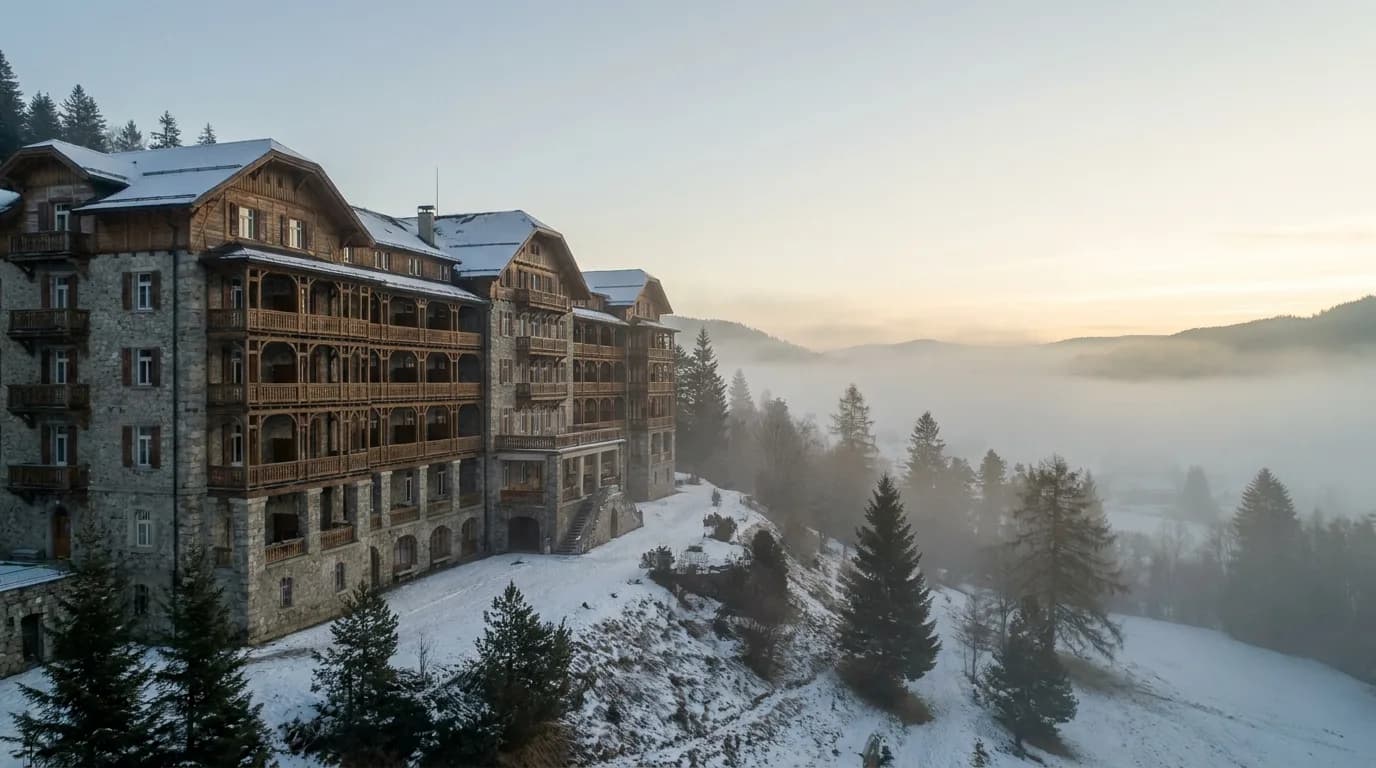
In the second half of the nineteenth century, doctors came to believe that the dry, clear, high-altitude air of Davos was a treatment for tuberculosis, then one of the deadliest diseases in Europe. Patients arrived from across the continent to take "the cure," and the town reshaped itself around them: grand sanatoriums were built on the slopes above the valley, with long south-facing balconies where patients would lie out in the cold mountain air for hours. For decades, Davos was synonymous with convalescence.
The Magic Mountain
That world produced one of the landmark novels of the twentieth century. Thomas Mann's The Magic Mountain (Der Zauberberg, 1924) is set in a Davos sanatorium, where a young visitor's brief stay stretches into years and the mountain becomes a closed world apart from time and ordinary life. Mann's wife had been a patient in Davos, and the novel drew on what he saw there. It fixed the town in the European imagination as a place of altitude, illness, and strange suspended time — an image that still lingers.
A town of artists and writers
Davos's reputation drew more than patients. The writer Robert Louis Stevenson spent time in Davos for his health and worked there. The expressionist painter Ernst Ludwig Kirchner moved to the town and spent his final years in the mountains above it, producing some of his most important work — now held in the town's Kirchner Museum. The high valley has a longer cultural and intellectual history than its modern conference fame suggests.
What remains
Antibiotics ended the era of the air cure, and the sanatoriums found new lives — most famously the Schatzalp, the historic sanatorium above Davos Platz that is woven directly into Mann's novel and survives today as a destination in its own right. The legacy is everywhere once you look: in the architecture of the old cure houses, in the town's self-image, and in the very thing that first made its name — the altitude that still defines a visit (more on that in Where is Davos?).
There's a satisfying continuity to it. The qualities that drew patients and writers a century ago — height, clarity, a sense of being apart from the ordinary world — are not far from what draws people to Davos now. Browse places to stay or get in touch to plan a visit with a sense of the town's past.